


Global Capability Centers (GCCs) Consulting Services: For AI-Native Capabilities
Global Capability Centers (GCCs) are centralized units established by multinational companies to manage critical business functions such as IT services, software development, customer support, data analytics, and innovation. These centers, often set up in strategic global locations, help organizations streamline operations, reduce costs, and access specialized talent pools. GCCs play a pivotal role in driving digital transformation, operational excellence, and innovation for enterprises worldwide.
ISHIR’s Global Capability Centers as a Service Model
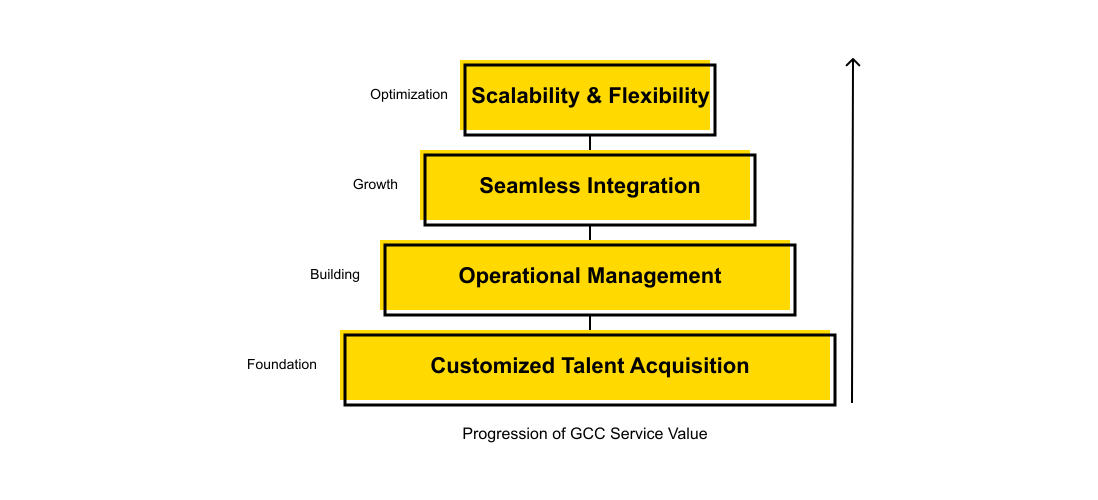
At ISHIR, we offer a flexible and scalable Global Capability Centers (GCC) as a Service model, empowering organizations to establish and manage high-performing global teams without the complexities of setting up a physical entity. Our services include:

Customized Talent Acquisition
Access to a diverse and skilled talent pool tailored to your business needs.

Operational Management
End-to-end management of your global center, including infrastructure, compliance, and performance metrics.

Seamless Integration
Ensuring your GCC aligns with your core business strategies and culture.

Scalability and Flexibility
Easily expand or reduce your global teams based on evolving business requirements.
Benefits and Impact of Establishing Global Capability Centers (GCC)
Implementing a GCC can deliver transformative benefits, including:
Cost Optimization
Significant reduction in operational costs through strategic location advantages and resource optimization.
Access to Global Talent
Leverage specialized skills from diverse global talent markets.
Operational Excellence
Streamlined processes and standardized operations enhance efficiency and productivity.
Innovation & Talent Acceleration
GCCs act as innovation hubs, driving research, development, and technological advancements.
Risk Mitigation
Diversified operations across global locations reduce dependency and business risks.
BOOT Model for Staff Augmentation
The Build Operate Optimize Transfer (BOOT) model is a strategic outsourcing approach designed to help businesses build global teams while aligning with long-term business goals. Unlike traditional staffing models focused solely on cost arbitrage, BOOT emphasizes talent quality, operational excellence, and strategic collaboration. ISHIR leverages over 25 years of experience to establish, manage, and optimize offshore or nearshore Global Capability Centers (GCCs) or Captive Capability Centers (CCCs), offering customized BOOT solutions across multiple regions globally.
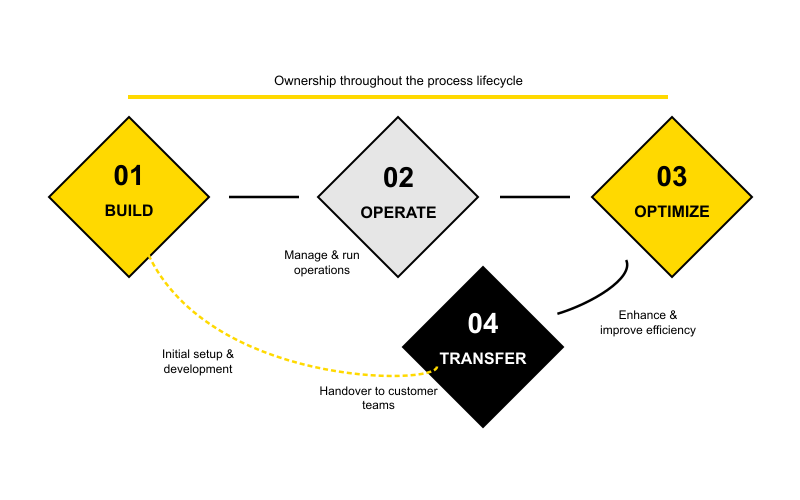

Build
Our team utilizes its established reputation and experience to create a foundation for your offshore or nearshore operations. This includes providing branded office space and secure business infrastructure. We implement a robust hiring process to assemble a talented team equipped with the capabilities your organization requires.

Operate
Leveraging our management and operational leadership, we relieve your executives of the burden of running the offshore or nearshore operations. Our enablement programs, developed over 25 years, guide local and global executives to work efficiently with your newly established semi-captive operations, establishing a culture that reflects your business values.

Optimize
We ensure success by measuring key performance indicators and continuously optimizing operations. Through training, coaching, certifications, and leadership development programs, we enhance the time to value. We also establish regular cadences with a task force to facilitate rapid resolution and effective communication.

Transfer
After a minimum of three years, we offer the option to transfer employees into your organization, enabling you to achieve further savings with your extended team. This ensures that long-term success is maintained at any capacity necessary for continued growth.
Benefits of the BOOT Model
- Immediate Cost Savings: Experience significant savings compared to traditional outsourcing models or U.S.-based operations.
- High Employee Retention: Achieve 93%+ employee retention rates.
- No Upfront Investment: There’s no need for upfront capital investment.
- Rapid Time to Market: Leverage our 25 years of experience and local reputation to accelerate your time to market.
- Strategic, Risk-Free Relationships: Enjoy a relationship that minimizes risks with minimal commitment.
- Address Talent Demand: Meet your escalating talent needs with dedicated extended teams.
- Right-to-Hire Flexibility: Transition employees to your organization, providing the option to hire with significant cost benefits.
Global Delivery Built by the best hybrid teams
Our global delivery model is built around your success: Dallas-based onshore teams ensure clear communication, rapid feedback loops, and complete alignment with your vision; our world-class offshore center in India brings top-tier engineering talent at competitive rates; and nearshore teams provide extended coverage and flexibility whenever your project demands it.
We design a blended execution model to maximize velocity, maintain shared ownership, and remove communication bottlenecks. The result is continuous progress, predictable delivery, and solutions that perform at enterprise scale.
Success Stories

![]() SageSure
SageSure
SageSure set out to transform its underwriting operations to better serve brokers, underwriters, and internal teams, but legacy tools and fragmented workflows stood in the way. ISHIR partnered with SageSure to develop a cloud-native, secure, and scalable platform tailored to streamline underwriting, enhance decision-making, and ensure compliance.

FAQs
What is a Global Capability Center (GCC)?
A GCC is a centralized business unit set up by organizations to deliver strategic support functions like IT, finance, HR, operations, and R&D. These centers operate globally to provide cost-effective, scalable, and specialized services, driving business efficiency.
How do GCCs help improve business efficiency?
GCCs centralize operations, reducing redundancy and enabling streamlined workflows. By leveraging skilled talent, advanced technology, and process standardization, they enhance productivity, ensure cost savings, and support faster decision-making.
Which industries benefit most from GCCs?
GCCs are valuable across industries such as:
- Technology: Software development and IT support.
- Healthcare: Data management and research.
- Finance: Back-office operations and analytics.
- Retail: Supply chain optimization and customer service.
- Manufacturing: Process automation and R&D.
Why do companies establish GCCs?
Companies establish Global Capability Centers (GCCs) to drive operational efficiency, reduce costs, and access global talent pools. GCCs enable organizations to centralize key functions like IT, finance, HR, and R&D, creating streamlined workflows and reducing redundancies. They act as hubs for innovation, fostering technological advancements, data analytics, and process optimization. By leveraging skilled expertise in strategic locations, businesses can achieve scalability, improve service quality, and enhance decision-making. Additionally, GCCs help companies remain competitive by aligning global operations with market demands, ensuring consistent delivery of high-value services while maintaining flexibility and agility.
How do GCCs contribute to innovation?
GCCs play a pivotal role in driving innovation by creating dedicated environments for research, development, and experimentation. These centers often focus on advanced technologies like AI, machine learning, and data analytics, enabling businesses to develop cutting-edge solutions. By centralizing expertise and resources, GCCs encourage cross-functional collaboration and knowledge sharing, which accelerates innovation cycles. They also provide a platform for businesses to pilot new ideas, test prototypes, and implement scalable solutions, helping organizations stay ahead of market trends and continuously improve their products and services.
Related Articles
Build vs. Rent: Should You Hire an In-House Forward Deployed Engineer or Bring In Fractional FDE Talent?
Enterprise AI has moved past experimentation. The problem is no longer whether your company can access advanced AI models, cloud platforms, coding assistants, or...

Why Your Internal Tech Team Is Struggling to Deploy AI, and How Forward Deployed Engineers Fix It
Why Your Internal Tech Team Is Struggling to Deploy AI, and How Forward Deployed Engineers Fix It If your internal tech team has spent...
AI-Native Global Delivery Models: Why Your Operating Model Matters More Than Where You Hire
The conversation around global software development has changed. For years, executives asked one question before launching technology initiatives. "Should we build onsite, offshore, or nearshore?" That...
Outcome-Based Software Delivery: Why Enterprise Leaders Are Moving Beyond Staff Augmentation and Resource-Based Contracts
Your software project is behind schedule. The budget has increased twice. The vendor has added more developers. Yet delivery velocity hasn't improved. If that sounds familiar, you're...
The AI-Native Organization: Redesigning Work, Talent, and Leadership for the Future[Hiring in the AI Era (Part 8)]
From Transformation to Operating Model This is the final part of an 8-part series on hiring in the AI era. Let’s quickly recap the journey:...
Closing the AI Adoption Gap: Ensuring Equitable Access, Capability, and Performance Across Your Workforce [Hiring in the AI Era (Part 7)]
From Onboarding to Measuring What Matters In Part 1, we explored the shift from execution to orchestration. In Part 2, we defined AI-first engineers and...
Measuring Performance in AI-First and AI-Native Teams: Redefining Productivity, Output, and Impact [Hiring in the AI Era (Part 6)]
From Onboarding to Measuring What Matters In Part 1, we explored the shift from execution to orchestration. In Part 2, we defined AI-first engineers and...
Onboarding and Scaling AI-First and AI-Native Teams: Turning Talent into Performance [Hiring in the AI Era (Part 5)]
From Hiring the Right Talent to Making Them Effective In Part 1, we explored the shift from execution to orchestration. In Part 2, we defined...
Interviewing and Assessing AI-First and AI-Native Talent: Moving Beyond Traditional Hiring Methods [Hiring in the AI Era (Part 4)]
From Job Design to Candidate Evaluation In Part 1, we established that work is shifting from execution to orchestration. In Part 2, we defined the...
Redesigning Job Descriptions for AI-First and AI-Native Organizations [Hiring in the AI Era (Part 3)]
From Talent Definition to Talent Attraction In Part 1, we established that work is shifting from execution to orchestration. In Part 2, we defined what...
Defining AI-First Engineers and AI-Native Engineers: The New Talent Blueprint [Hiring in the AI Era (Part 2)]
From Understanding the Shift to Defining the Talent In Part 1, we established a foundational shift: Work is moving from execution to orchestration. Humans are no...
From Task Execution to AI-Orchestrated Work: Why Hiring Process Must Be Rebuilt [Hiring in the AI Era (Part 1)]
This Is Not a Hiring Adjustment. It Is a Reset Most hiring strategies today are built for a structure of work that is already...
Why AI Is Increasing Demand for Software Engineers (Not Replacing Them)
AI Is Not Replacing Engineers. It’s Raising the Stakes Every few years, a new technology triggers the same question in boardrooms and leadership discussions:...
What Makes India a Preferred Destination for Software Development, Innovation, and AI in 2026?
India software development outsourcing in 2026 is no longer about labor arbitrage. It is about capability density, AI engineering depth, digital product velocity,...
Why 70% of AI Projects Fail & How Forward Deployed Engineers Change the Equation
AI Projects Are Failing at an Alarming Rate Enterprise AI adoption is accelerating. Budgets are growing. Boards expect measurable outcomes. Yet most AI initiatives...
How Relevant Is the Chief AI Officer? CAIO as Change Agent Orchestrating AI Across Strategy, Operations, and Culture
How Relevant Is the Chief AI Officer in the AI Era? Over the past few years, artificial intelligence has shifted from isolated experimentation to...
Why Senior Software Engineers Will Matter More (In 2026) in an AI-First World
In 2026, writing code is no longer the hard part. AI can generate features, refactor services, and accelerate delivery at scale. Speed is...
How IT Staff Augmentation Bypasses Hiring Freezes and AI Disruption
Hiring freezes were supposed to slow spending, not sabotage delivery. Yet IT leaders today are expected to ship more products, adopt AI, modernize...
Can A Fractional Tech Team Really Deliver Enterprise-Grade Software Products?
Building software products used to be simple: hire engineers, give them laptops, ship code. Today it’s a gladiator arena. Markets shift overnight, customer...
Establishing a High-Performing Global Capability Center (GCC): Strategic Leverage for Mid-Market & Enterprise Organizations
In today’s competitive digital environment, organizations face pressure to reduce operational costs, accelerate innovation, access global talent, and align technology teams with brand...
Client Reviews

Devon Vincent
Director Business Intelligence, Valiant Enterprises
Ganesh Vishwakarm
Director, TrellisTract